
Fresh Dog Food Subscriptions on Shopify: What Your Platform Needs to Handle (2026)
Short answer
A fresh or raw dog food subscription is a plan for a specific dog, not just a customer. Portions and price depend on the dog's weight, age and activity, the box arrives frozen or chilled, and the kitchen needs a cutoff to cook to order. On Shopify, pick a subscription platform that handles per-dog plans, portion changes, delivery-day control and order cutoffs, not just a repeating charge.
Most Shopify subscription apps were built for replenishment: the same product at the same price, charged every 30 days. Coffee, supplements, razors. Fresh dog food breaks all three of those assumptions. The product is sized to a dog, the price moves when the dog does, and the box is frozen or chilled, so the day it lands matters more than the day it's charged.
That's the idea behind delivery-first subscriptions, and the wider problem is covered in our guide to fresh product subscriptions. This post gets specific: the maths behind a dog's plan, what it means for box sizes and delivery schedules, and a checklist to hold any subscription platform against.
Why is every dog's plan different?
Vets and pet food brands size a daily portion from the dog's resting energy requirement (RER): 70 × body weight in kg to the power of 0.75. That covers the dog at rest. The daily requirement is RER multiplied by a life-stage factor: 1.6 for a neutered adult, 1.8 for an intact adult, 1.4 for dogs over seven and 2.0 for puppies over four months.
| Dog weight | Resting (RER) | Neutered adult | Intact adult | Senior, 7+ | Puppy, 4 months+ |
|---|---|---|---|---|---|
| 5 kg | 234 | 374 | 421 | 328 | 468 |
| 10 kg | 394 | 630 | 709 | 551 | 787 |
| 20 kg | 662 | 1,059 | 1,192 | 927 | 1,324 |
| 30 kg | 897 | 1,436 | 1,615 | 1,256 | 1,795 |
| 40 kg | 1,113 | 1,781 | 2,004 | 1,559 | 2,227 |
Two things fall out of this table. First, a 40 kg dog eats nearly five times what a 5 kg dog does, not eight times, because energy scales with body weight to the power of 0.75. Price can't be a flat rate per kilo of dog, and it can't be one price per plan. It has to be worked out per dog.
Second, the numbers move. A puppy's needs change month to month, a neutered adult needs around 10% less than an intact one, and a dog on a weight-loss plan eats less again. Every change is a new portion and, usually, a new price.
How much food goes in each box?
Fresh recipes are mostly water, so they carry fewer calories per kilo than kibble. Labelled fresh cooked recipes commonly sit between about 1,000 and 1,700 kcal per kg. At 1,200 kcal per kg, this is how much a neutered adult eats.
| Dog weight | Per day | Per week | Every 2 weeks | Every 4 weeks |
|---|---|---|---|---|
| 5 kg | 312 g | 2.2 kg | 4.4 kg | 8.7 kg |
| 10 kg | 525 g | 3.7 kg | 7.3 kg | 14.7 kg |
| 20 kg | 883 g | 6.2 kg | 12.4 kg | 24.7 kg |
| 30 kg | 1,196 g | 8.4 kg | 16.7 kg | 33.5 kg |
| 40 kg | 1,485 g | 10.4 kg | 20.8 kg | 41.6 kg |
This is why delivery cadence has to be set per dog as well. A four-weekly box for a 5 kg dog is under 9 kg of food. For a 30 kg dog it's over 33 kg of frozen food, which is more than a lot of households have room for. Big dogs usually need smaller, more frequent boxes, and a household with a 5 kg dog and a 30 kg dog needs two very different plans on one delivery.
Why does the delivery day matter so much for frozen food?
Frozen and chilled boxes are built to survive a window, not a week. ProDog Raw packs its boxes to last up to 60 hours in transit and still warns that summer heat and courier delays can soften the food. It also stopped weekend deliveries altogether after repeated courier problems, moving Saturday orders to Monday. Different Dog sends customers a one-hour courier slot on the day, with a simple rule for boxes left outside: if the pots are still cool to the touch, they're fine to refreeze.
Every one of those is a decision about the delivery day. The customer needs to see when the box arrives, move it when they're away, and never have it land on a day nobody can take it in. When a platform is built around the charge date, moving a delivery usually means moving a billing date and hoping fulfilment follows. Get it wrong and a failed delivery costs you the food, a second courier run, a support conversation and, often, the customer.
What should a fresh dog food subscription platform handle?
Hold any platform, including ours, against this list.
| Requirement | Why it matters | What to ask the vendor |
|---|---|---|
| Per-dog plans | Each dog has its own weight, age, activity and recipe, so its own portion and price. Multi-dog homes need a plan per dog, not one blended order. | Can one customer have a separate plan for each dog, with its own portion and price? |
| Portion and price updates | Puppies grow, adults gain or lose weight and seniors slow down. The plan should change when the dog does. | When a dog's weight or life stage changes, do portion and price update without starting a new subscription? |
| Delivery-day control | Frozen boxes survive a limited window. Customers need to see and move the delivery day, not the charge date. | Does the customer portal lead with the next delivery, and can customers move a single delivery? |
| Order cutoffs | Cook-to-order kitchens need volumes locked days ahead. Late edits make a mess of production. | Can you set a cutoff before each delivery, after which changes apply to the next box? |
| Delivery days by area | Frozen couriers run set days in each area, and many brands avoid weekend delivery. | Can delivery days be limited by region or courier schedule? |
| Skip and pause by delivery | "I'm away next Thursday" should be one click on that delivery, not a sum about billing dates. | Are skip and pause tied to deliveries or to billing cycles? |
| Migration | Moving hundreds of active dogs, each with a portion and a schedule, is the scariest part of switching. | Is migration done for you, and does it carry each dog's plan across? |
What does subscription software cost a fresh dog food brand?
Fresh dog food orders are big and frequent, so percentage and per-order fees add up fast. Recipe mixing matters too: on Recharge, Build-a-Box sits on the Plus plan, which comes with a 12-month contract. Here is what a fresh dog food brand pays at an $80 average order.
| Subscription revenue | Orders a month | Recharge Starter | Recharge Plus | Gro | Gro saving vs Starter, per year |
|---|---|---|---|---|---|
| $30K/mo | 375 | $617 | $972 | $270 | $4,167 |
| $50K/mo | 625 | $963 | $1,288 | $450 | $6,153 |
| $100K/mo | 1,250 | $1,826 | $2,076 | $900 | $11,118 |
| $150K/mo | 1,875 | $2,690 | $2,865 | $1,350 | $16,083 |
The full breakdown at six revenue levels is in Recharge pricing explained, and every app's fees side by side are in our comparison of the best Shopify subscription apps.
How Gro handles fresh dog food subscriptions
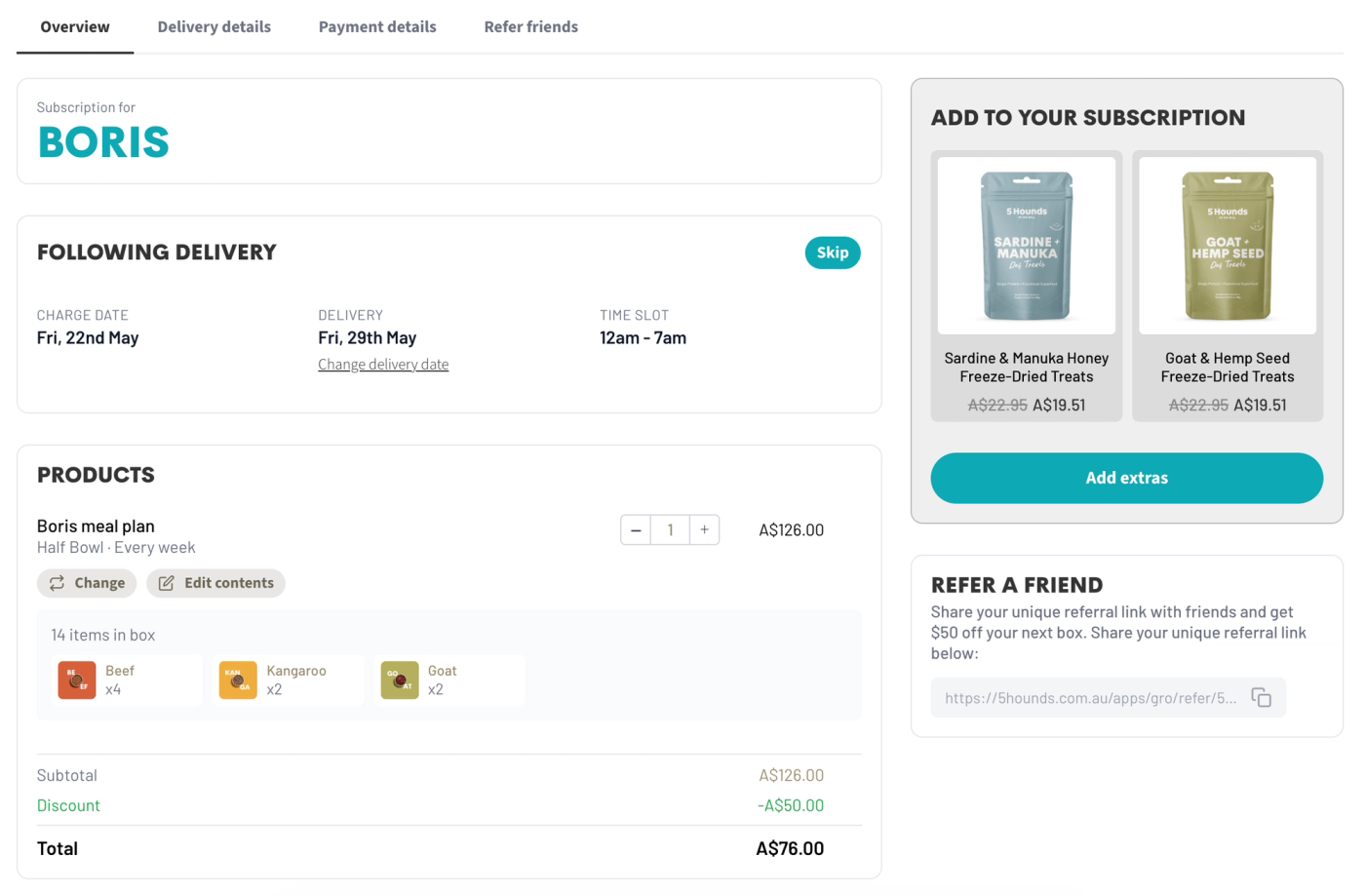
Full disclosure: Gro is ours. It was built alongside 5 Hounds, a fresh dog food brand in Australia, so most of the checklist above came straight out of their operations.

“Since implementing Gro, we’ve seen meaningful improvements across the business. It’s played a significant role in helping us scale more efficiently, and the customer portal has significantly cut our support tickets along the way.” Will, founder of 5 Hounds
- Each dog is its own plan, with its name, weight, portion and life stage. When the dog's weight or life stage changes, the portion and price change with it. Multi-dog households can have their dogs delivered together or separately.
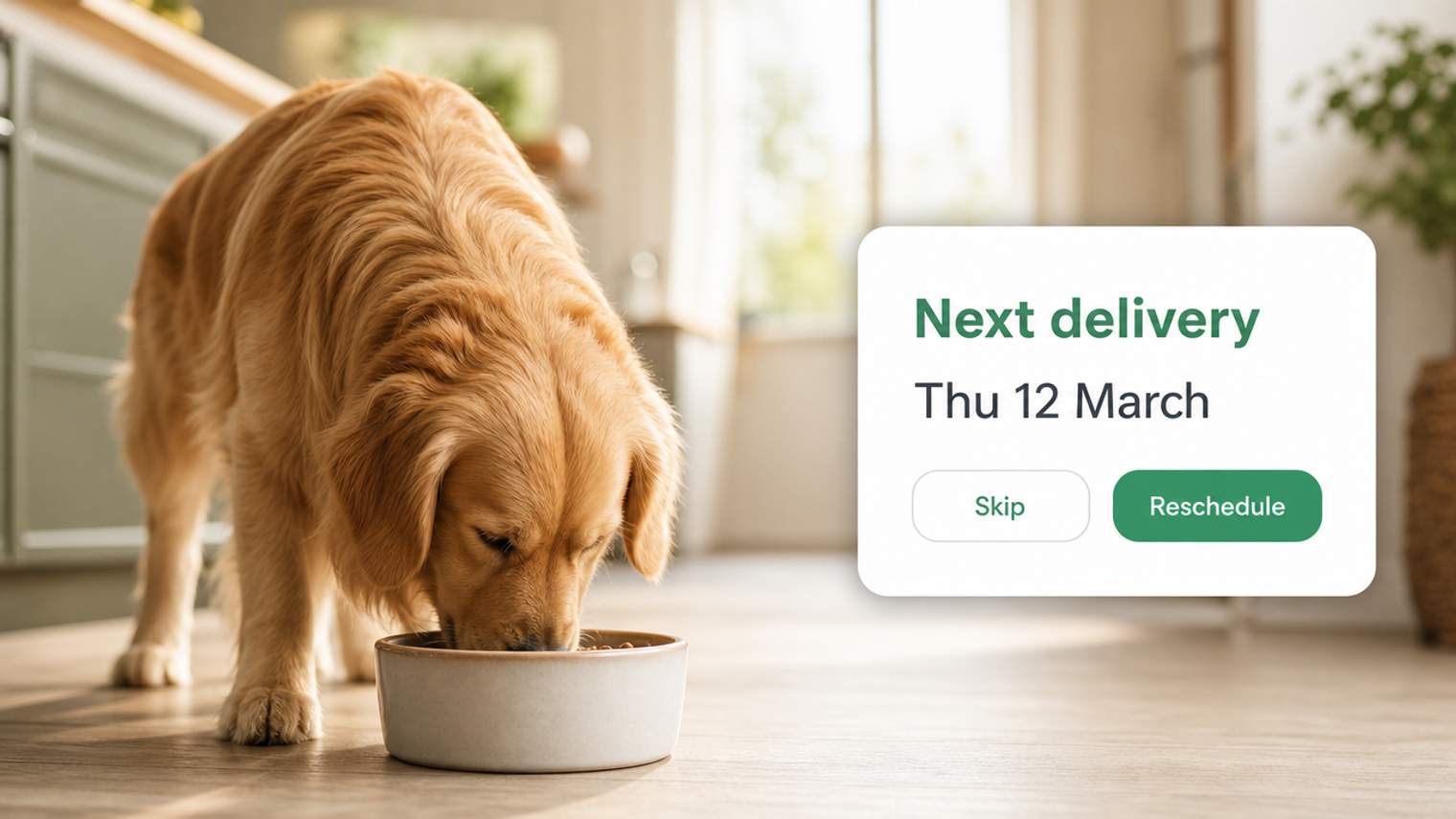
- The customer portal leads with the next delivery. Skip, reschedule and pause act on a specific delivery, not a billing cycle.
- A deadline before each delivery for changes, so the kitchen knows exactly what to cook.
- 0.9% of subscription revenue with a $250 a month minimum and no per-order fee, free under 10 active subscriptions. Migration from Recharge is free and done for you.
If you run a fresh or raw dog food brand on Shopify, see how Gro works.
Related reading
Frequently asked questions
The customer sets up a plan for their dog based on weight, age, activity and recipe. The brand works out a daily portion, cooks to order, freezes or chills the food and delivers on a set schedule, usually every one to four weeks. Customers can skip or move deliveries, and the plan should update as the dog changes.
Roughly 300 to 1,500 grams, depending on size. A neutered adult needs about 1.6 times its resting energy of 70 × body weight in kg to the power of 0.75, so a 20 kg dog needs about 1,060 kcal a day, or around 880 g of a fresh recipe at 1,200 kcal per kg.
Yes. Shopify handles products, checkout and orders, and a subscription app handles the recurring plan. For fresh dog food, choose an app that supports per-dog plans, delivery-day scheduling and order cutoffs, not just a repeating charge.
Usually every one to four weeks, set by the dog's size and the customer's freezer space. A 5 kg dog eats about 8.7 kg of fresh food in four weeks, while a 30 kg dog eats about 33 kg, so larger dogs often need smaller, more frequent boxes.
Gro is free under 10 active subscriptions, then 0.9% of subscription revenue with a $250 a month minimum and no per-order fee. At $50K a month in subscription revenue that is $450. Migration from Recharge is free.
One built around the dog and the delivery date rather than the billing date: per-dog plans that re-price when a dog's weight changes, a portal that leads with the next delivery, order cutoffs for cook-to-order kitchens, and no per-order fees on frequent boxes. Gro was built with 5 Hounds, a fresh dog food brand in Australia, for exactly this, at 0.9% of subscription revenue.
Building a delivery-first brand on Shopify?
We'd like to talk. The migration's on us.
 ChatGPT
  Claude
  Perplexity
  Grok
Grok