
Delivery-first subscriptions: a better model for brands that ship perishables
Short answer
Delivery-first subscriptions make the delivery, not the billing date, the centre of the subscription. Customers see their next delivery day, skip or reschedule a specific box, and billing follows the delivery schedule. For fresh, frozen, refrigerated or high-value products, that control means fewer failed deliveries, refunds and cancellations. Gro is a Shopify subscription platform built this way, at 0.9% of subscription revenue with no per-order fee.
The best subscription brands have something in common. They obsess over the moment the box arrives.
Not the moment the card gets charged. Not the renewal date in the customer portal. The moment a real human meets a real box at a real door.
That's the moment loyalty is won or lost. A fresh dog food delivery that arrives on a planned Thursday, with a heads-up the day before and a porch that's clear and shaded, builds the kind of customer who stays for years. The product is great, sure, but the experience is what compounds.
This post is about how to build a subscription business around that moment. We call it delivery-first, and it's the model we think the next generation of Shopify subscription brands will be built on.
What delivery-first actually means
Most subscription tools treat billing as the source of truth. A charge happens, a fulfilment follows. The customer's relationship with the brand is anchored to a card transaction.
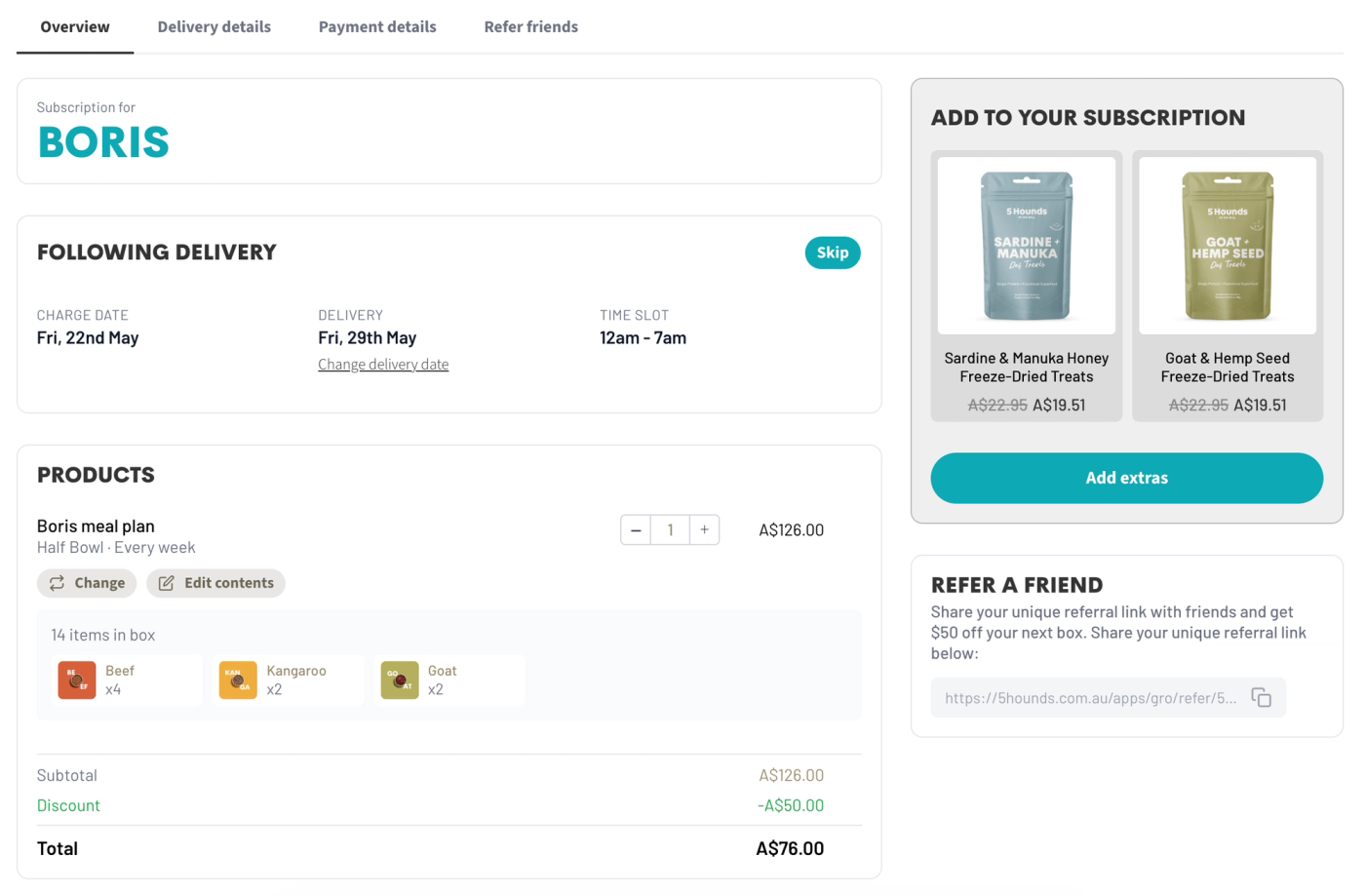
Delivery-first flips that. The delivery is the primary object. Billing happens because a delivery is scheduled. The customer sees, manages, and plans around the day the box arrives, not the day they get charged.

It sounds like a small shift. In practice it changes almost everything about how the customer experiences the subscription.
The portal leads with "your next delivery is Thursday May 30" instead of "your next charge is May 28". Notifications follow the delivery date: a heads-up three days out, tracking on the day, a "did it arrive ok?" check-in after. Skip, reschedule, change address and edit contents all anchor to the delivery day. The customer is in control of when the box shows up, which means they're set up to be home for it.
For brands shipping anything temperature sensitive or high value, that control is the whole game.
Why this matters more than ever
Subscription commerce has grown up. The early days of "set it and forget it" replenishment worked because the products were shelf-stable. Coffee, supplements, razors, toilet paper. The box could sit on a porch for hours and nothing bad happened.
The fastest-growing categories now are different:
Fresh and frozen pet food. Meal kits. Flowers. Refrigerated supplements. Skincare with active ingredients that hate heat. Premium coffee delivered at peak freshness. Subscription wine. Kids' snack boxes with chocolate that melts in summer.
For these brands, the box arriving on the right day with the right person home isn't a nice-to-have. It's the product working as designed. A melted box of treats isn't a delivery issue, it's a brand experience issue, and customers churn over it.
The brands building in these categories deserve tools that treat delivery as the main event. If you're running a fresh, frozen or refrigerated brand specifically, we've written a deeper guide for you.
What delivery-first changes
When you build around the delivery rather than the charge, several things get easier.
Fewer failed deliveries. Customers know exactly when the box is coming, so they plan for it. Skip flows are anchored to the delivery date, which is how customers actually think about their subscription. "I'm away Thursday" is a one-click skip, not a calculation about which charge to cancel.
Better margins. Every failed delivery is a margin hit: a replacement to send, a refund to issue, support time to handle. Even a small drop in failure rate compounds fast across hundreds of monthly shipments.
Higher trust. Customers who know when their box arrives recommend the brand. Customers who get surprised at their door churn and tell their friends. The delivery experience is one of the most underrated growth levers in subscription commerce.
Easier ops. Your fulfilment team works to a delivery schedule. Your customer support team can answer "when's my box coming" without checking three tools. Your marketing team can build campaigns around the delivery moment, not just the renewal.
Entity-aware: the next layer
Delivery-first opens up another idea worth getting excited about.
A lot of subscriptions aren't really "for" a customer. They're for a pet, a kid, a vehicle, a household member. The subscription should reflect that.
A pet food subscription is for Bowie the kelpie, 18kg, currently eating chicken and rice. When Bowie grows, the food changes, the portion size changes, and so does the price. The subscription evolves with the animal, not with the cardholder.
A kids' clothing subscription is for Mia, age 3, size 4T. When she grows, the next box is a different size. The subscription tracks the kid.
A car wash subscription is for the white Ford Ranger. If the household gets a second car, that's a second subscription, not a confusing single line item.
Entity-aware subscriptions feel obvious once you see them, and they're impossible to retrofit into a billing-first platform. The data model has to be right from the start.
Who delivery-first is for
Recharge works. But it still leaves a sub-optimal customer experience on the table: confusing portals, skip flows tied to charge dates instead of delivery days, support tickets about "when's my order coming". If you want better, speak to us. The migration's on us.
If you ship anything where the day matters, fresh food, frozen, refrigerated, flowers, high-value items, or anything tracking a specific pet, kid or vehicle, you'll feel the difference even more. Your support tickets, your churn rate and your replacement costs all live downstream of the delivery experience. Building around it pays back.
What we're building
Gro is a Shopify subscription platform built delivery-first from the ground up. The customer portal leads with the next delivery. Skip and reschedule flows are anchored to delivery dates. Entity-aware subscriptions are first-class. The data model treats deliveries as the primary object, not billing cycles.
We also built it to be simple. Two products under one umbrella (Subscriptions and Email), sold separately, both designed for brands that want powerful tools without the enterprise weight. Subscriptions cost 0.9% of subscription revenue with a $250 a month minimum and no per-order fee, free under 10 active subscriptions. Email is free up to 1,000 sends a month, then $39 a month for up to 150,000 sends. Migrations from Recharge are free.
Gro is built by a team that spent years inside subscription billing and operations, so it targets the problems we already watched break. We're deliberate about who we onboard because we'd rather support a brand properly than chase logos. If you're building a delivery-first brand on Shopify, we'd like to talk.
Related reading
Frequently asked questions
Delivery-first subscriptions treat the delivery as the main object instead of the billing date. The customer sees and manages their next delivery day, skips and reschedules move a specific delivery, and billing follows the delivery schedule rather than driving it.
A billing-first platform schedules a charge and lets fulfilment follow. A delivery-first platform schedules the delivery and charges because of it. For shelf-stable products the difference is small. For fresh, frozen or refrigerated products it decides whether the customer is home when the box arrives.
Brands where the delivery day matters: fresh and frozen pet food, meal kits, flowers, refrigerated supplements and skincare, high-value items, and any subscription that tracks a specific pet, kid or vehicle.
Subscriptions attached to the thing being served, such as a pet, a child or a vehicle, rather than only the cardholder. A dog food plan tracks the dog's weight and life stage, so portions and price change as the dog does, and two dogs mean two plans.
Yes. Gro is a Shopify subscription platform built delivery-first: the portal leads with the next delivery, skips and reschedules anchor to the delivery date, and subscriptions can be entity-aware. Pricing is 0.9% of subscription revenue with a $250 a month minimum and no per-order fee, free under 10 active subscriptions.
Building a delivery-first brand on Shopify?
We'd like to talk. The migration's on us.
 ChatGPT
  Claude
  Perplexity
  Grok
Grok